News and Events

SNBS Launched The Commencement of the MICS-7 Survey

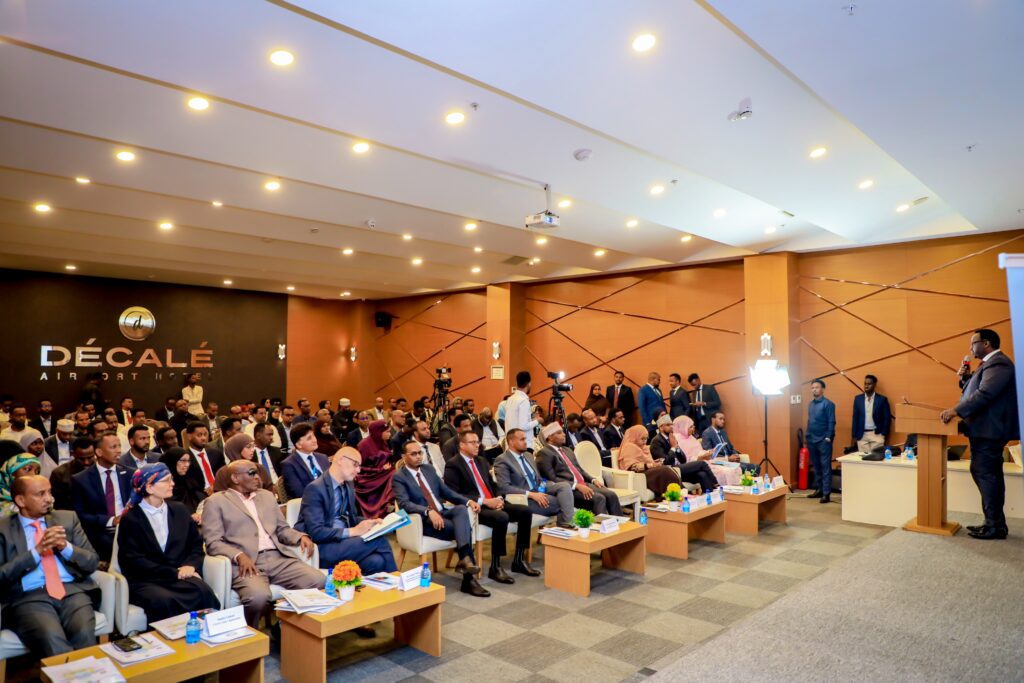
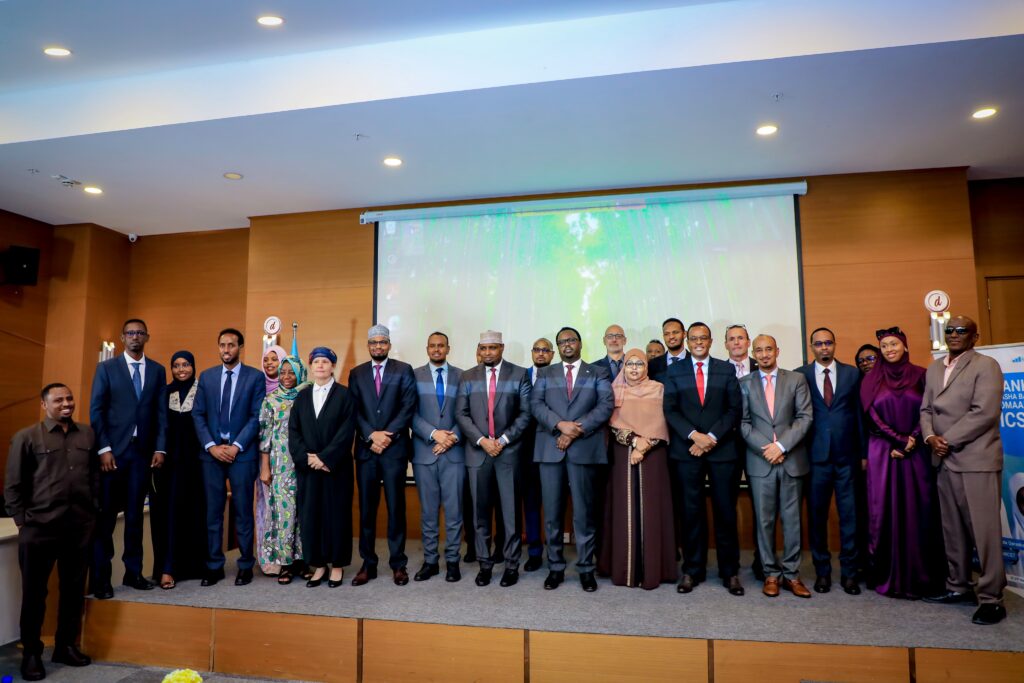
SNBS launched the commencement of the MICS-7 Survey in a high-level event unveiled by H.E. Salah Ahmed Jama, Deputy Prime Minister of Somalia. The hybrid event brought together Federal & Federal Member State Ministers, including the Minister of Planning & the Minister of Labor, senior government officials, representatives from UN, World Bank, UNICEF, WHO, civil society, academia & the media.

In his opening Address, the Deputy Prime Minister stressed the centrality of data for national transformation: “If a Somali child is healthy & educated, s/he embodies human capital—the true wealth of a nation. MICS-7 will provide the indicators needed to craft Somalia’s National Human Capital Development Strategy.” He further called on all relevant ministries to ensure that the data generated from the survey is used for prudent & requisite policy interventions that directly improve the lives of Somali citizens.

SNBS Director General, Dr. Abdisalam Mohamed, underlined the importance of the survey for policymaking: “Without credible data, policy remains guesswork; with it, policy becomes precision. MICS-7 is a collective investment in knowledge, accountability & shared future of every Somali child, woman & family.” He further noted the survey will cover 17 of the 18 pre-war regions.

Delivering the closing remarks, H.E. Mohamud Abdirahman Sheikh Farah (Beenebene), Minister of Planning Investment & Economic Dev. reaffirmed government ownership of the process, noting, “this survey marks a new chapter in evidence-based policy. It will guide our efforts to build a resilient, equitable & prosperous Somalia.”

SNBS extends deep appreciation to development partners—World Bank, UNICEF & WHO—for their technical partnership & support in making this landmark survey possible. With 168 indicators & 47 SDG measures, the majority focused on human capital, MICS-7 signals a new era for Somalia’s data-driven development.
SNBS Launched The Commencement of the MICS-7 Survey Read More »

Annual Performance Newsletter – 2025

A Year of Institutional Transformation

The year 2025 stands as a defining milestone in the institutional evolution of the Somalia National Bureau of Statistics and the broader National Statistical System. As Somalia advances implementation of the National Transformation Plan (2025–2029) and lays strategic foundations for Vision 2060, the demand for credible, timely and internationally harmonized statistics has assumed unprecedented importance.

In an increasingly complex development landscape, official statistics are no longer peripheral technical outputs but strategic national imperatives. Official statistics inform macroeconomic management, underpin fiscal planning, guide social investment, strengthen governance accountability and enable Somalia to report authoritatively on its national priorities and global commitments, including the Sustainable Development Goals.

Annual Performance Newsletter – 2025 Read More »

SOMALIA JOINT MONITORING REPORT 4

Biannual update on food and nutrition security crisis risks December 2025 – REPORT #4

This Joint Monitoring Report (JMR) for Somalia, which uses data up to November 2025 and statistical modelling to highlight food and nutrition security risks at the district level, recorded 41 critical and 61 heightened risk alerts in November compared to 31 critical and 68 heightened risk alerts recorded in October last year. It is estimated that 1,729,000 people (9.07% of the population) lived in areas at risk of experiencing Emergency (IPC Phase 4) or worse food insecurity conditions across several regions.

The five regions with districts at the highest risk of experiencing food and nutrition security deterioration, in order of severity from highest to lowest, are Lower Shabelle, Gedo, Bay, Sanaag, and Lower Juba. The top 10 districts at risk are Qoryooley, Wanla Weyn, Doolow, Buurhakaba, Ceerigaabo, Baydhabo, Diinsoor, Afgooye, Adan Yabaal and Baardheere.

SOMALIA JOINT MONITORING REPORT 4 Read More »

SNBS congratulates our Director General, Dr. Abdisalam Mohamed

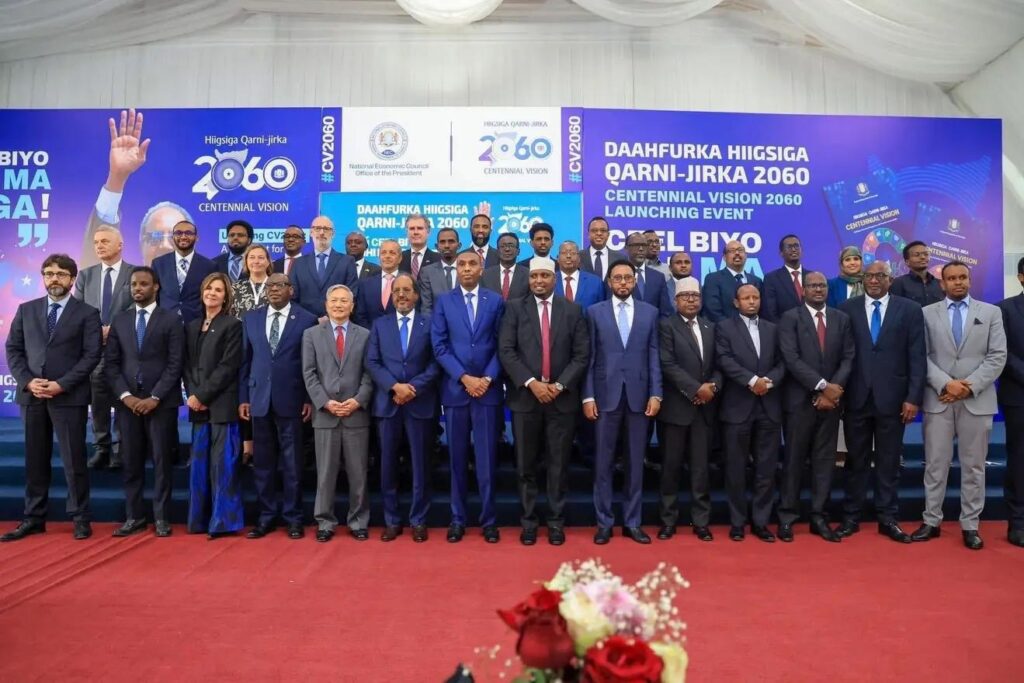
SNBS congratulates our Director General, Dr. Abdisalam Mohamed, on receiving a Presidential Award at the launch of Vision 2060. As a former member of the National Economic Council, Dr. Abdisalam contributed significantly to the research & strategic groundwork that shaped this transformative national agenda. We Thank H.E. President, Dr. Hassan Sheikh Mohamud and H.E. Prime Minister Mr. Hamza Abdi Barre for their visionary leadership. As Somalia embarks on implementing Vision 2060 via the National Transformation Plan (2025–2029), SNBS continues delivering high-quality & timely data needed to track progress, shape policy & ensure no one is left behind. Our mission is to make data the backbone of Somalia’s development journey.

SNBS congratulates our Director General, Dr. Abdisalam Mohamed Read More »

SOMALIA JOINT MONITORING REPORT 3

UPDATE ON FOOD AND NUTRITION SECURITY CRISIS RISKS JUNE 2025 – REPORT #3

The Joint Monitoring Report (JMR) for Somalia, which uses data available up to April 2025 and statistical modelling to highlight food and nutrition security (FNS) risks at the district level, recorded 14 critical and 52 heightened risk alerts1 in April. It also estimated that approximately 702,000 people (3.7% of the population) live in areas at risk of deteriorating into Emergency (IPC Phase 4) or worse food insecurity conditions across several regions. This compares to April 2024, when 56 critical and 56 heightened risk alerts were recorded, affecting an estimated 620,000 people.

The top five regions in Somalia at risk of experiencing a food and nutrition security deterioration are Sanaag, Middle Shebelle, Sool, Awdal, Galgaduud, and Bay. The top 10 districts at risk are Ceerigaabo, Las qorey, Adan Yabal, Cadale, Balcad, Lascanod, Caynabo, Taleex, Baki, and Diinsoor.

SOMALIA JOINT MONITORING REPORT 3 Read More »

Second Joint Data and Statistics Forum

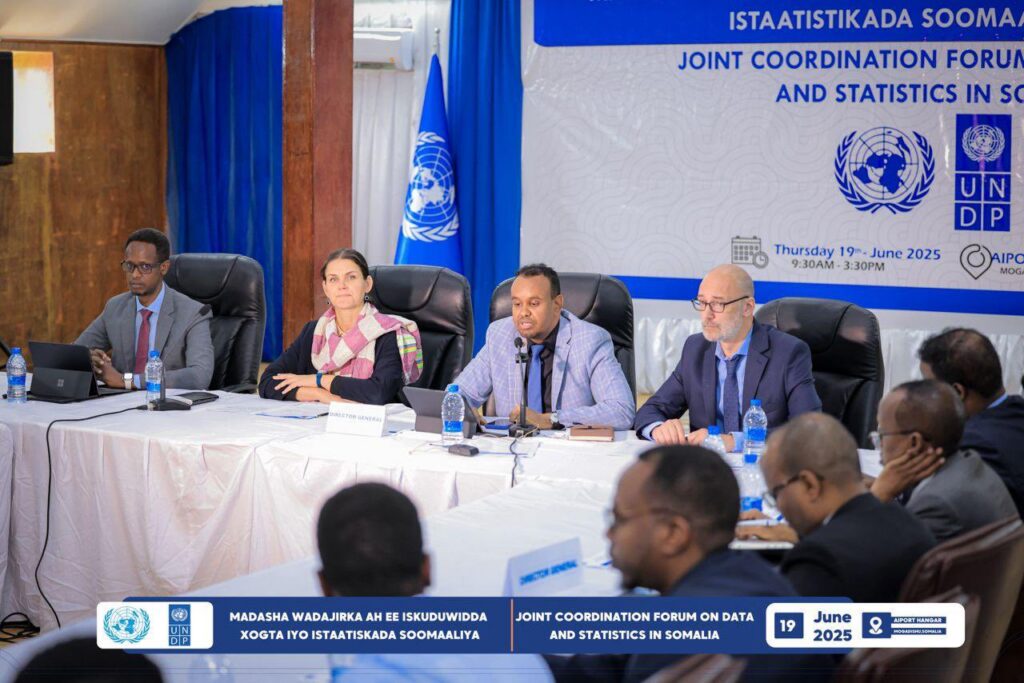
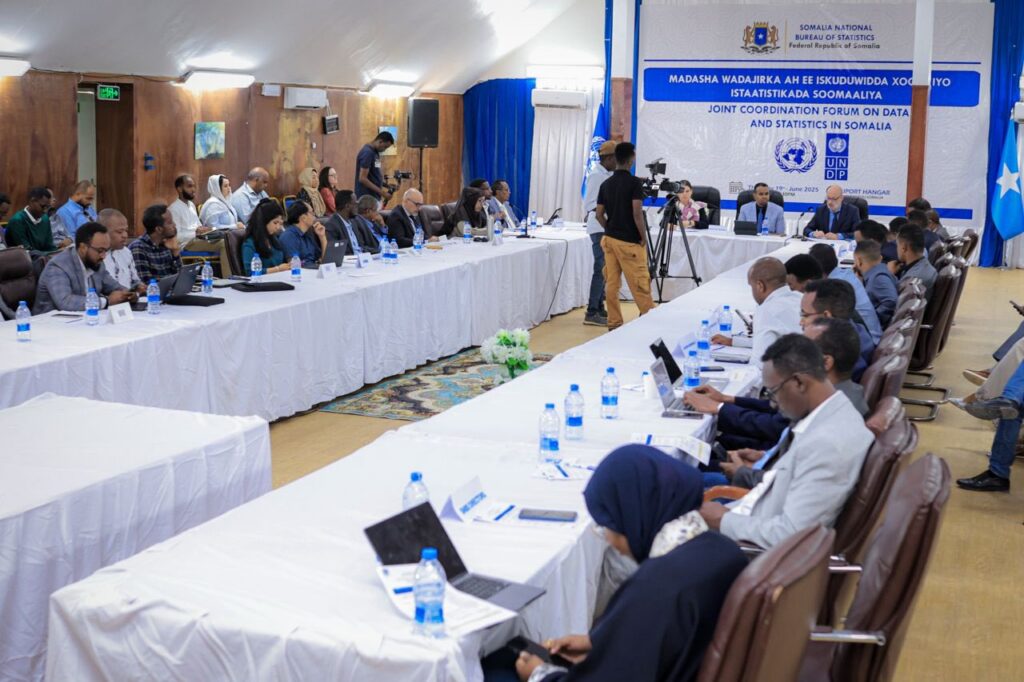
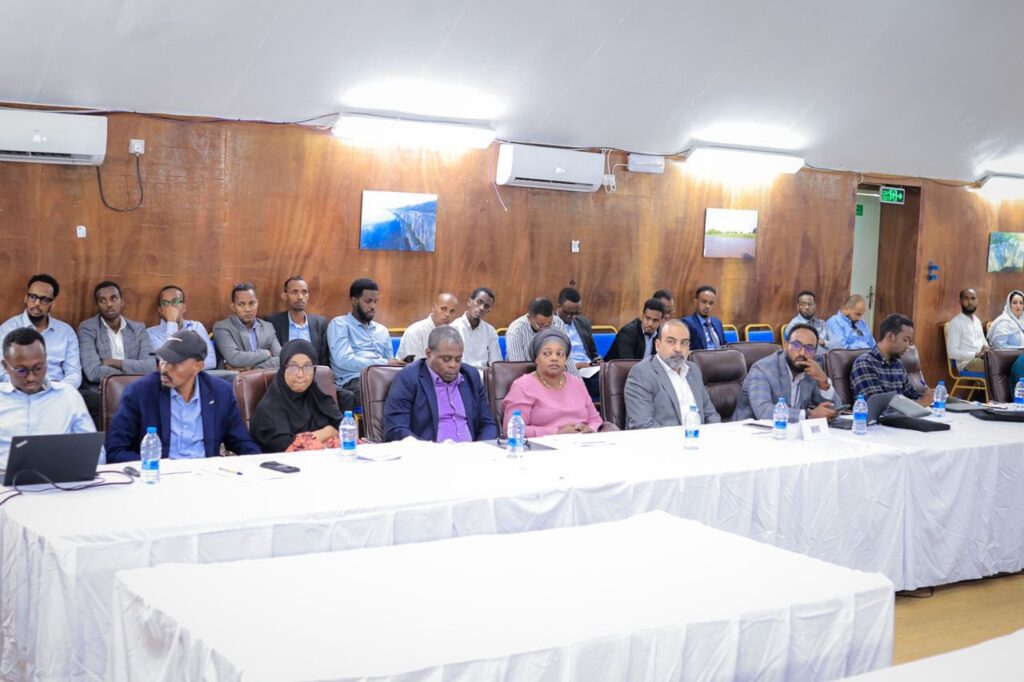
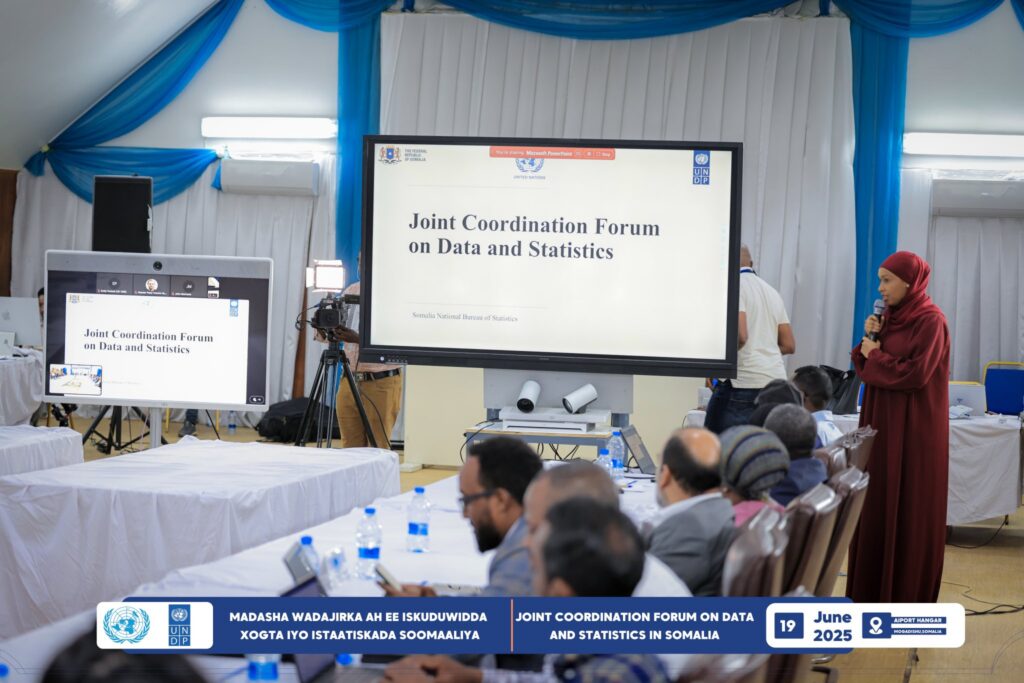
In June 2025, SNBS convened Second Joint Data and Statistics Forum, bringing together more than 130 representatives from government institutions, development partners and international agencies. The Forum reaffirmed SNBS’s statutory leadership as Somalia’s national authority for official statistics. Key outcomes included improved administrative data-sharing mechanisms, reduced duplication in data production, clearer delineation of institutional roles and strengthened coordination for VNR 2026 preparations.

Second Joint Data and Statistics Forum Read More »

Modernizing Somalia’s Statistical Infrastructure: The CPI Reform Initiative

The modernization of Somalia’s Consumer Price Index represents a cornerstone of our broader statistical infrastructure development strategy. This initiative directly addresses the critical need for robust macroeconomic indicators to support evidence-based policy formulation and facilitate Somalia’s continued integration into the global economy. Technical Innovations and Methodological Advancements.

Comprehensive Data Foundation

The project has established a new empirical foundation for CPI calculations based on the 2022 Somalia Integrated Household Budget Survey (SIHBS). This extensive survey captured consumption patterns across 7,212 households from 601 enumeration areas, with stratified sampling across urban, rural, and nomadic populations—achieving a remarkable 96% response rate.

Modernizing Somalia’s Statistical Infrastructure: The CPI Reform Initiative Read More »

SOMALIA JOINT MONITORING REPORT 2

UPDATE ON FOOD AND NUTRITION SECURITY CRISIS RISKS DECEMBER 2024 – REPORT #2

This Joint Monitoring Report (JMR) for Somalia, which uses data up to October 2024 and statistical modeling to highlight food and nutrition security risks at the district level, recorded 31 critical and 68 heightened risk alerts1 in October and estimated that 500,500 people (2.82% of the population) lived in areas at risk of deteriorating into Emergency (IPC Phase 4) or worse food insecurity conditions across several regions.

The five regions with districts at the highest risk of experiencing food and nutrition security deterioration, in order of severity from highest to lowest, are Sanaag, Gedo, Lower Juba, Galgaduud, and Woqooyi Galbeed. The top 10 districts at risk are Ceerigaabo, Laasqoray Beledxaawo, Afmadow, Ceel-buur, Ceel-Afweyn, Zeylac, Badhaadhe, Kismayo, and Buuhoodle.

SOMALIA JOINT MONITORING REPORT 2 Read More »

SOMALIA JOINT MONITORING REPORT

UPDATE ON FOOD AND NUTRITION SECURITY CRISIS RISKS JULY 2024 – REPORT #1

The Joint Monitoring Report (JMR) for Somalia, which uses data up to April 2024 and statistical modeling to highlight food and nutrition security risks at the district level, recorded 56 critical and 56 heightened risk alerts1 in April and estimated that 620,000 people (3.31% of the population) lived in areas at risk of deteriorating into Emergency (IPC Phase 4) or worse food insecurity conditions across several regions.

The five regions with the highest risk of experiencing food and nutrition security deterioration were Galgaduud, Gedo, Sanaag, Togdheer, and Woqooyi Galbeed. The ten districts with the highest risk were Beledxaawo, Berbera, Cabudwagg, Ceel Afweyn, Ceel Buur, Ceeriggabo, Doolow, Garbahaarrey, Hargeysa, and Lasqorey.

SOMALIA JOINT MONITORING REPORT Read More »

Assessment and Mapping of the Migration Data Production Capacities of the Government of Somalia

This report is based on an assessment and mapping exercise, which was informed primarily through key informant interviews conducted during and after a mission to Mogadishu, Somalia in March of 2022. The assessment employed the Toolkit to assess national migration data capacity, an assessment questionnaire which was developed by the United Nations Statistics Division in 2018 to assess national capacity of producing reliable, timely, and comparable statistics on international migration and to identify areas where capacity building is needed. This report includes key recommendations and priority action areas, including the establishment of a migration data technical working group and the production of a thematic report on migration using existing survey data.

Assessment and Mapping of the Migration Data Production Capacities of the Government of Somalia Read More »

Scroll to Top